
TL;DR: An automation testing tool runs scripted or AI generated checks against web, mobile, and API interfaces and reports results to your CI pipeline. QA leads choosing one in 2027 should score it on four criteria: coverage across web, mobile, API, SAP, and Salesforce; self healing when locators change; native CI/CD integration; and the cost of maintaining tests, which comes back every release. ContextQA, our product, is built as the autonomous quality engineer for all four.
Choosing a test automation platform in 2027 is harder than it should be. Your suite has to cover web, mobile, API, SAP and Salesforce, survive UI changes, and run in CI/CD without one engineer spending all week on maintenance. This guide gives the selection criteria first, then a plain comparison, so you can build a shortlist by Monday.
Quick answers
These three answers cover what QA leads and engineering managers ask most often when they shortlist test automation software.
What criteria should a QA lead use to choose a test automation platform in 2027? Score four things: coverage across your interfaces (web, mobile, API, database, SAP or Salesforce), self healing of selectors when the UI changes, CI/CD fit with Jenkins, GitHub Actions, Jira and Slack, and maintenance cost. That last one includes who can write tests (a no code recorder, or code only) and exit cost, such as Playwright export. Then pilot one real non production journey and judge the evidence.
Can one tool cover web, mobile, API and SAP or Salesforce, or do we need several? Some platforms cover all of them from one suite. Test packaged app depth separately: SAP Fiori, S/4HANA, SAP GUI and Salesforce Lightning are harder to test than a standard web form. ContextQA, our product, covers them end to end, with SAP on the Enterprise plan. Prove any tool on one cross system workflow first.
How do we adopt a new tool without rewriting our process and pipeline? Pick a tool that plugs into your CI system, your issue tracker and your engineers' AI coding assistants, and that exports code so your tests are not locked in. Run one regression journey beside your current suite. ContextQA connects to Jenkins and GitHub Actions, exports to Playwright, and works from Cursor or Claude Code through its MCP server.
What is an automation testing tool?
A test automation tool is software that runs predefined checks against an application, compares actual behavior to expected results, and reports pass or fail, so nobody has to click through each step by hand. Teams use these tools to run regression suites on every build and catch breakages before a release ships.
Tools differ on coverage (web, mobile, API, packaged apps), authoring (code, a no code recorder, or AI generation), whether tests survive a changed button or field, and whether they plug into pipelines such as Jenkins or GitHub Actions. Those traits set your maintenance cost, which often matters more than the license price.
Open source or commercial: Open source frameworks cost nothing to license, but your team owns the test runner, reporting, browser grid, and every broken locator fix. Commercial platforms charge a fee and include execution infrastructure, self healing (automatic repair of broken selectors), and vendor support.
What can test automation software do?
Test automation software drives web, mobile, and API interfaces, compares actual results with expected ones, and saves evidence from every run. Stronger platforms also generate tests from requirements, repair broken locators, and report failures inside your CI/CD pipeline, so a red build arrives with the context needed to fix it.
- Author tests: Record a journey, write code, or generate draft tests from tickets, designs, or API specs. A person reviews generated tests before they count as coverage.
- Execute at scale: One suite runs in parallel across browsers and devices, on demand or from a CI step.
- Self heal: The tool notices when a selector (the attribute a test uses to find an element) changes and repairs it. ContextQA, our product, does this with AI based self healing.
- Capture evidence: Screenshots, video, logs, and traces turn a red build into a defect your team can diagnose.
- Keep an exit: Some platforms, ContextQA included, export to Playwright.

Why does test automation matter in 2027?
Code now ships faster than people can check it by hand. AI assistants write more of each pull request, and release pipelines need regression evidence on every merge. If your automated checks do not run in CI and do not survive UI changes, that extra speed turns into failed releases and late rollbacks.
The Stack Overflow Developer Survey 2024 found that 76% of respondents were using or planning to use AI tools in development. Google Cloud's DORA 2024 Accelerate State of DevOps report estimated that a 25% increase in AI adoption was associated with a 7.2% drop in delivery stability.
For SaaS teams, that leads to two requirements:
- Open authoring. Testers who do not code should add coverage without waiting on framework work. ContextQA offers a no code test recorder alongside code aware generation.
- Pipeline execution. The tool should run as a step in GitHub Actions or Jenkins, fail the build, and report to Jira or Slack. A tool that only runs from a laptop cannot block a bad release.
How does a test automation platform work?
A test automation platform turns a requirement or a recorded user journey into a repeatable test. It runs that test against a test environment, on demand or from CI/CD, saves evidence, and reports a result. Most long term cost comes from keeping those tests working as the application changes.
- Capture intent. Import requirements from tickets, documents or designs, or record a journey in a non production environment.
- Generate or author tests. The tool drafts steps and assertions. A person reviews them.
- Organize and parameterize. Group tests into suites and plans, and keep test data separate from environment values.
- Execute. Run tests in parallel across browsers, devices and APIs, manually or from CI.
- Analyze and maintain. Review the evidence, triage failures and fix broken locators.
ContextQA follows this loop, as described in its product guide, and repairs broken selectors automatically. Enterprise teams should push hardest on step 5: run one real SAP or Salesforce journey through two UI releases. Total cost of ownership is licenses plus infrastructure plus maintenance hours.
Which approach fits your team?
The right choice depends on who writes your tests and what they have to cover. Teams with strong SDETs and one web app often do well with an open source framework. Teams that must cover web, mobile, API, SAP and Salesforce without enough specialist coders need a platform that keeps maintenance low. ContextQA, compared below, is our product.
| Option | Best for | Pricing model | Notable tradeoff |
|---|---|---|---|
| ContextQA (our product) | End to end coverage of web, mobile, API and enterprise apps | Demo and quote, see pricing | SAP testing and on premises deployment require the Enterprise plan |
| Open source code framework | Teams with many SDETs testing web and API | Free license, paid in engineering hours | You build and maintain the grid, the reporting and the locator fixes |
| Legacy record and playback tool | Manual testers writing their first scripts | Varies by vendor | Recorded scripts break when the UI changes |
Pick the option whose maintenance cost your team can actually carry.
How does ContextQA approach test automation?
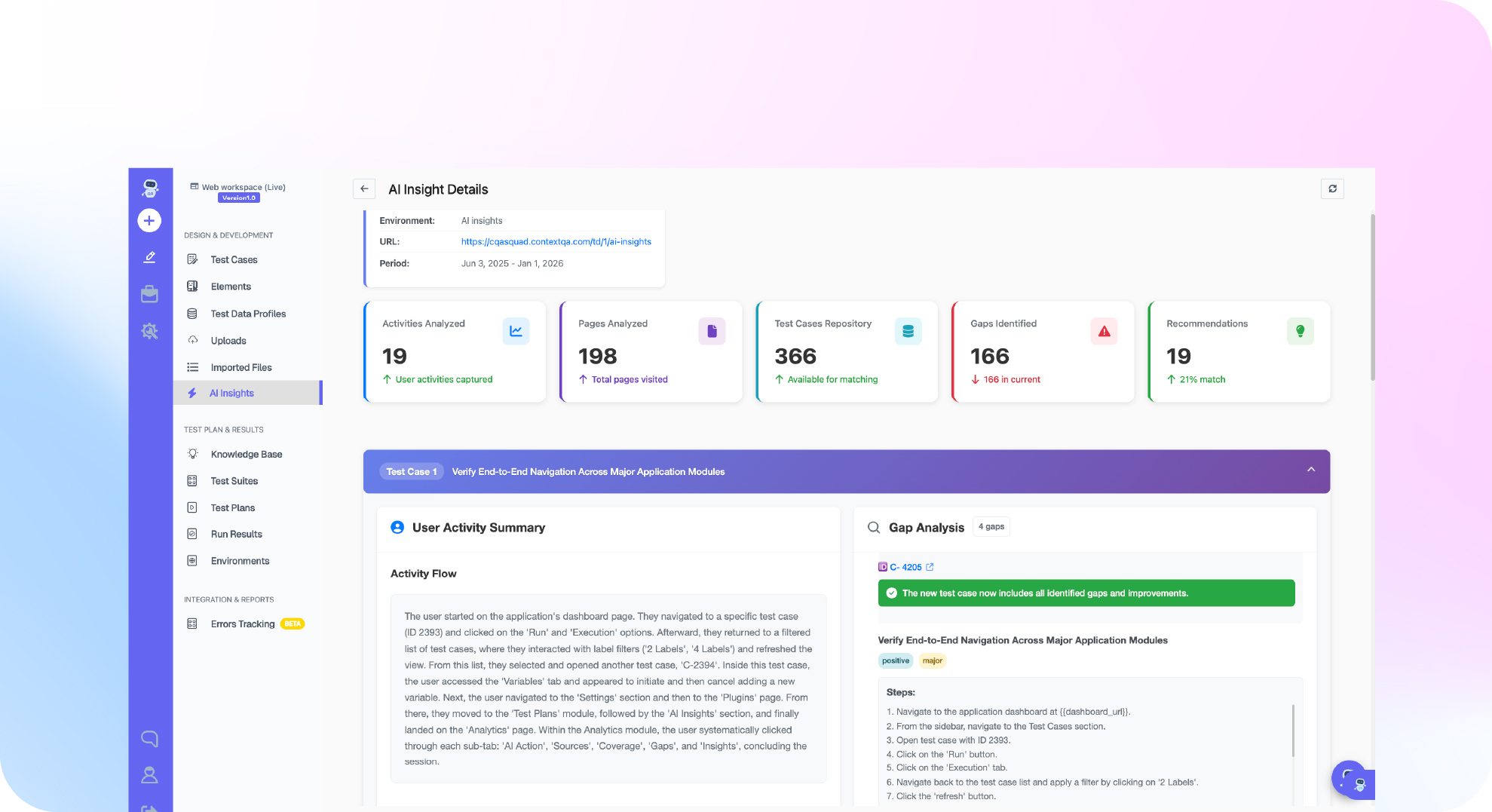
ContextQA, our product, is an autonomous quality engineer, not a script library. Give it a flow, a ticket, a Figma file, a Swagger spec or a code change. It generates tests for happy paths, edge cases and failure states, runs them across browsers and devices, and repairs broken locators when the UI changes.
The workflow from the Complete Product & Workflow Guide:
- Author: Record a journey in the no code recorder or generate tests from requirements. A person reviews each generated test before it runs.
- Run: One suite runs in parallel on Chrome, Safari, Edge, Firefox, iOS and Android. Trigger it from Jenkins or GitHub Actions, and results go to Jira, Slack or GitHub.
- Drive from the IDE: The MCP server gives Claude Code, Cursor and Codex 50 testing tools that you call in plain English.
- Leave anytime: Code export produces Playwright code.
With a driver framework, your team writes and fixes every selector. ContextQA includes self healing and root cause analysis. Enterprise pricing comes as a quote after a demo.
If one suite has to cover web, mobile, API, SAP and Salesforce without selectors breaking every release, book a demo to see ContextQA run against your own workflows.
What should you do now? A checklist
Pick one business journey, define the coverage it needs, and run the same pilot on every vendor on your shortlist. Score each on self healing after a real UI change, CI integration and weekly maintenance hours, and pick the tool whose evidence holds up on your stack.
- Write down one non production journey and its expected result before you book any demos.
- Change one selector in the app and confirm the test repairs itself.
- Trigger a run from a
Jenkinsfileor a GitHub Actions workflow, and confirm results post to Jira or Slack. - Run one suite in parallel on Chrome, Safari, Edge, Firefox, iOS and Android.
- Export the test to Playwright code and run it outside the vendor's platform.
- Ask a tester who does not write code to build one test.
- Track maintenance hours per tool each week during the pilot.
- Confirm the deployment model your security team requires: cloud SaaS, your own cloud, self hosted or on premises.
Bottom line
Choose an automation testing tool by the coverage you need and what it costs to maintain: web, mobile, API, SAP and Salesforce from one suite, plus self healing, CI integration and an exit path such as code export. Pilot one real business journey and judge the evidence before you commit to a contract.
For ERP depth, see what SAP testing automation involves.
Sources
The statistics in this guide come from the two public 2024 reports below and are cited inline. ContextQA capability claims link to the matching page on contextqa.com or learning.contextqa.com.