
TL;DR: Exploratory testing means a tester learns the product, designs tests and runs them all at once. The work happens in time boxed sessions, each guided by a written charter, and it finds bugs that scripted checks miss. This guide uses a time box of 60 to 90 minutes. Jonathan and James Bach formalized the method as session based test management in 2000. It is not ad hoc clicking. It works alongside automation. With ContextQA, the autonomous quality engineer, a tester can write or record the bugs a session finds as automated regression cases.
Exploration without structure turns into clicking that leaves no evidence. This guide covers how to write a charter, run a session, hold a debrief, and turn what you find into bugs and regression cases.
Quick answers
How long should an exploratory testing session last? A practical time box is 60 to 90 minutes. Session based test management, which Jonathan and James Bach described in 2000, organizes exploration into time boxed sessions. That length gives a tester enough time to learn a feature and test it, while keeping them on a single charter. Hold a short debrief after each session.
What is the difference between exploratory testing and ad hoc testing? Ad hoc testing is unplanned clicking with no stated goal and no record of what was covered. An exploratory session runs inside a time box with a written charter, such as "explore checkout with expired cards to discover payment error handling." The tester takes notes, applies heuristics and holds a debrief, so other people can review and repeat the work.
Does exploratory testing replace test automation? No. Automation repeats known checks on every build. A chartered session looks for problems nobody has written a check for yet. Use both. Once a session confirms a bug, file a bug report and add an automated regression case. In the ContextQA platform, a tester can write that case as plain English steps or record it with the no code recorder, then run it in CI/CD.
What is exploratory testing, and when do you need it?
Exploratory testing is simultaneous learning, test design and execution, run in time boxed sessions guided by a charter. Each test the tester picks depends on what the previous one revealed. That is how it finds bugs scripted checks miss, such as broken state transitions, interrupted flows and edge cases nobody wrote down. You need it whenever behavior is new, risky or poorly specified.
Scripted testing, manual or automated, confirms the behavior someone expected in advance. Exploration questions that behavior. A common charter template is "explore X with Y to discover Z." Elisabeth Hendrickson popularized it, and it did not come from session based test management.
Heuristics are rules of thumb that point to likely failures. Testers use them throughout a session:
- Boundaries: zero, the maximum, and one past the maximum.
- Interruptions: the back button, an expired session, a dropped network.
- State changes: editing after submit, or opening one record in two tabs.
Run sessions on new features and risky releases. Also run them on areas where customers keep reporting bugs while the automated suite stays green.
What do you need before you start?
You need five things before your first session: a deployed build in a stable test environment, test accounts and data, a one line charter, a time box of 60 to 90 minutes, and a place to log notes and bugs. You also need to agree on which risks people will explore and which ones automation already checks.
| Option | Best for | Cost model | Notable tradeoff |
|---|---|---|---|
| Exploratory session | New features, risky changes, unclear requirements | Tester hours per session | Coverage depends on the charter and the tester's skill |
| Scripted manual test | Compliance steps, one off acceptance | Tester hours per run | Repeats one path and finds little new |
| Automated regression in CI/CD | Known flows on every merge | Build and maintenance time | Checks only what someone predicted |
On agile and CI/CD teams, explore a feature once it reaches staging. Then automate what you learn so regression covers it on every merge. The main risk is exploratory work that nobody documents and nobody can repeat. Measure the return on each session by counting bugs filed by severity and findings turned into regression cases.

How do you run a session, step by step?
A session follows the structure from session based test management: a charter, a time box, running notes and a debrief. You apply heuristics during the session to decide what to try next. Afterward, you turn the findings into bug reports and regression cases.
- Write the charter. Use the form "explore X with Y to discover Z." For example: explore checkout with expired saved cards to discover how payment errors are handled.
- Time box the session. Give one tester 60 to 90 minutes without interruptions.
- Take notes as you go. Record each test you tried, each bug, each open question, and how long setup took.
- Apply heuristics. Try boundaries, interruptions (refresh in the middle of a submit) and state changes (log out in a second tab).
- Debrief within a day. Review what you covered, what you missed and which charter comes next.
- Turn each confirmed bug into a regression check:
test('refresh during payment does not create a duplicate order', async ({ page }) => {
await page.goto('/checkout');
await page.getByRole('button', { name: 'Pay now' }).click();
await page.reload();
await expect(page.getByTestId('order-count')).toHaveText('1');
});
To scale this across teams, keep charters in a shared backlog ranked by risk and hold debriefs every week.
What are the most common mistakes?
The most common mistakes are starting without a charter, letting sessions run with no end time, keeping no notes, skipping the debrief, and leaving findings in a chat thread instead of the bug tracker. Any one of them turns a structured session back into ad hoc clicking, and the bugs it finds never become regression coverage.
- No charter: replace "click around checkout" with "explore X with Y to discover Z."
- No time box: sessions drift all afternoon. Stop at 60 to 90 minutes.
- No notes or debrief: nobody can reproduce the bug. Log the steps, data and build, and hold the debrief the same day.
- Unreviewed AI output: nobody checked the generated cases. Review steps and assertions before you save them.
Convert each finding on the day you find it. AI can draft a regression case, but the tester decides what matters.
How do you know it is working?
A session works when its findings change what ships. Count the bugs that get fixed, the regression cases added to the suite, and the risky areas marked as covered. The number of sessions you ran tells you little, because a full calendar does not mean lower release risk.
Research offers a useful comparison. A 2007 controlled experiment by Itkonen, Mäntylä and Lassenius found no significant difference in defect detection efficiency between exploratory and test case based approaches. The test case based approach did produce more false defect reports (ESEM 2007). Exploration also avoids the up front cost of writing those cases.
Track these per session:
- Charter coverage: finished charters compared with the risk areas you planned.
- Time split: time spent on testing, bug investigation and setup. If setup takes most of the session, your environment is slowing testers down.
- Conversion rate: the share of findings that became filed bugs or automated regression cases.
For engineering managers and CTOs, report a risk map showing finished charters and open areas, because bug counts alone are easy to game. Agencies and startups that outsource sessions should still write their own charters and require notes and a debrief every time.
How do you automate what a session finds with ContextQA?
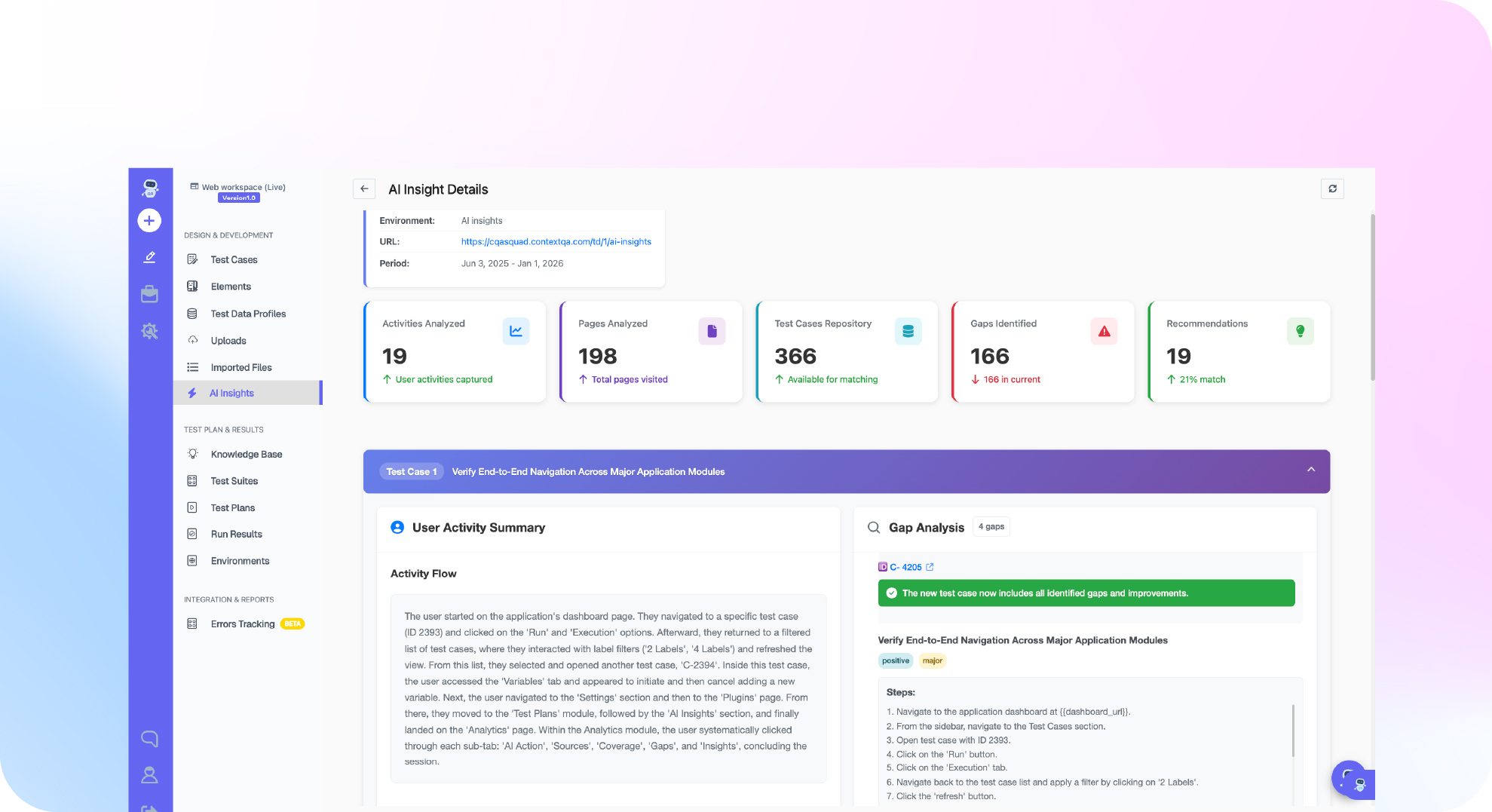
The judgment behind exploration can't be automated, but what a session produces can. With ContextQA, a tester takes each bug or risk from the session notes and writes it as a plain English test case or records it as a flow. The case then runs as a self healing regression check in CI/CD, so the session's findings keep getting checked.
In the debrief:
- Open Test Cases → New Test Case and write the path from your notes as steps, such as "Submit the form with an invalid email, verify the error message says 'Invalid email'" (ContextQA docs for testers). You can also paste a Jira ticket URL to generate cases.
- For long flows, click through once with the no code recorder.
- Put the boundary values you tested into a CSV so each row runs separately through data driven testing.
- Add the cases to a test plan and run it from Jenkins or GitHub Actions. From Claude Code or Cursor, use the MCP server. Code export gives you Playwright code.
This step shows why structure matters. Random clicking leaves you nothing to convert. A charter and session notes give you the exact steps.
If the bugs your sessions find keep coming back because nobody turned them into regression cases, book a demo and see how ContextQA runs those checks.
What should you do right now?
This week, pick one risky feature, write a one line charter, and run a single session of 60 to 90 minutes. Take notes, debrief within a day, and turn every confirmed bug into a ticket and an automated regression case. That completes your first loop, and it needs no new budget or tools.
- Choose the feature with the most recent incidents or code churn.
- Write a charter, for example: "Explore checkout with expired cards and slow networks to discover payment state errors."
- Block 90 minutes on the calendar and turn notifications off.
- Open
session-notes.mdwith sections for setup, bugs, issues and questions. - Apply boundaries, interruptions and state changes.
- Hold a 15 minute debrief with your QA lead.
- File each bug with steps, expected and actual results, and evidence.
- Pick the next charter from the open questions in the debrief.
Bottom line
Exploratory testing works when you treat it as a discipline. That means a charter, a 60 to 90 minute time box, running notes, heuristics such as boundaries, interruptions and state changes, and a debrief that turns findings into bugs and regression cases. It is not ad hoc clicking, and it does not replace automation. On Monday, schedule one chartered session on your riskiest release area, then automate what it finds.
Sources
The method and research claims in this article come from the primary sources below. Product steps come from the ContextQA documentation for testers and from the linked product pages on contextqa.com.
- Jonathan Bach, Session Based Test Management (2000)
- Itkonen, Mäntylä and Lassenius, Defect Detection Efficiency: Test Case Based vs. Exploratory Testing, ESEM 2007
- ContextQA, For Testers