
TL;DR: The SDLC (software development life cycle) is the overall sequence of plan, analyze, design, build, test, deploy and maintain. The spiral model is one way to run that sequence. Barry Boehm described it in his 1986 spiral model paper (ACM SIGSOFT, 1986). Each loop sets objectives, analyzes risk, builds and tests, then plans the next loop. Testing happens in every loop, so ContextQA, the autonomous quality engineer, can generate tests from each loop's tickets and run them in CI.
If you are weighing sdlc vs spiral model, you are not choosing between two rival options. The SDLC is the full life cycle, and the spiral model is one way to run it when risk is high. This guide covers when the spiral fits, where testing happens in each loop, and what to automate.
Quick answers
When should an engineering team choose the spiral model over agile or waterfall? Choose the spiral model when a project carries large risks that are hard to estimate, such as a new architecture, regulatory exposure or a costly integration. Each loop reduces the biggest open risk before more budget is committed. Agile is usually cheaper for small, well understood products, and waterfall fits fixed requirements.
Where does testing happen in each loop of the spiral model? Testing sits in the build and test quadrant of every loop. The risk analysis step before it decides what that loop's tests must prove. Each loop ends with evidence, such as prototype results, regression runs and defect trends, and that evidence feeds the plan for the next loop.
What should QA automate first in a spiral model project? Start with regression checks for behavior that earlier loops already validated, because each new loop builds on it. Next, automate tests for the risks named in the current loop's risk analysis, and run both sets in CI every loop. On the ContextQA platform, teams generate test cases from requirements and review them, and self healing repairs broken locators between loops.
What is the difference between SDLC and the spiral model?
The SDLC (software development life cycle) is the full set of work every product goes through: plan, analyze, design, build, test, deploy and maintain. The spiral model is one way to run that work. Each loop repeats four steps: set objectives, analyze risk, build and test, then plan the next loop. Risk gets reviewed at every turn.
The main difference is scope. The SDLC names the phases. The spiral model sets their order and how often you return to them. Boehm's 1986 paper presented it as a risk driven alternative to document driven waterfall. Each loop is meant to settle the biggest open risk, such as an unproven integration or an unclear requirement, before money goes into the next loop.
The spiral fits projects with uncertain requirements, large or regulated systems, and failures that cost a lot when found late, such as an ERP migration or a payments rewrite. The risk reviews add overhead, so a small team shipping a low risk SaaS feature usually does better with agile sprints.
What does pairing the SDLC with the spiral model do for a team?
The SDLC defines every phase a product goes through, from planning to maintenance. The spiral model runs those phases in repeated loops, with a formal risk review before each loop commits budget. Together they tell a team what work exists, what order to do it in, and how much risk each step carries.
- Scope set by risk: Each loop names the riskiest unknowns and resolves them with prototypes or simulations before building (Boehm, 1986).
- Earlier failure signals: Every loop runs build and test as its third step, before the team plans the next loop, so a bad integration or performance assumption shows up early instead of at final acceptance.
- Regression that grows each loop: Tests from earlier loops must keep passing, so coverage builds up instead of being rewritten.

Why does the SDLC vs spiral model choice matter in 2026?
The choice matters in 2026 because AI assisted coding produces changes faster than many teams can review them. A risk review at each loop catches costly design mistakes before they ship. Weak testing is costly at scale: NIST estimated that an inadequate infrastructure for software testing cost the US economy $59.5 billion a year (NIST, 2002).
Delivery expectations have shifted too. In the DORA 2024 Accelerate State of DevOps Report, 19% of respondents were elite performers, who deploy on demand and recover from failed changes in under an hour.
For most SaaS product teams, that pace favors agile. Spiral fits better when a single wrong decision is expensive, as in payments, regulated data, ERP migrations or safety critical integrations.
- Advantages: risks surface before the build, prototypes test the unknowns, and scope can change at every loop.
- Disadvantages: risk analysis takes senior time, documentation grows with each loop, and small projects pay for overhead they do not need.
How does the spiral model work inside the SDLC?
The SDLC defines what work happens, and the spiral model defines its order. In his 1986 paper, Boehm describes running the phases in repeated loops, with risk deciding how big each loop is. Every loop includes testing, so testing runs throughout the project instead of once near the end. A loop has four steps:
- Set objectives. Choose the loop's goal, constraints and alternatives. Write acceptance criteria that QA can test against.
- Analyze risk. Rank the unknowns and resolve the top ones with a prototype or a spike, which is a short experiment built to answer one question. QA decides what evidence closes each risk.
- Build and test. Build the increment, then run unit, integration and end to end checks. Automate regression here, because every later loop runs it again.
- Plan the next loop. Review results with stakeholders and decide whether to continue, change scope or stop.
Which approach fits your team best?
Pick a model based on how much is still unknown and how much a late change costs. Waterfall fits stable, fixed scope work. The V model fits regulated systems that need a test for every requirement. Agile fits SaaS teams that ship weekly. The spiral model fits large, high risk programs where each loop must retire a named risk first.
| Model | Best for | Cost of change | Where testing happens | Tradeoff |
|---|---|---|---|---|
| Waterfall | Fixed, well understood scope | High late | One phase after build | Defects surface late |
| V model | Regulated, audited systems | High late | Planned per phase, run after build | Heavy documentation |
| Agile | SaaS shipping weekly | Low | Every sprint, in CI | Architecture risk can drift |
| Spiral | Large, high risk programs | Moderate, checked per loop | Every loop, before the next commitment | Needs skilled risk analysis |
For engineering managers, a risk driven process means budget gets approved one loop at a time, senior people spend time on risk review, and nobody can fix the full timeline on day one.
Many CI/CD teams never say "spiral" but keep its habits: a risk review each iteration, prototypes to test assumptions, and a regression gate before every commitment. In practice, run agile for daily delivery and add spiral style risk reviews to programs where one wrong call costs more than a sprint.
How does ContextQA handle sdlc vs spiral model?
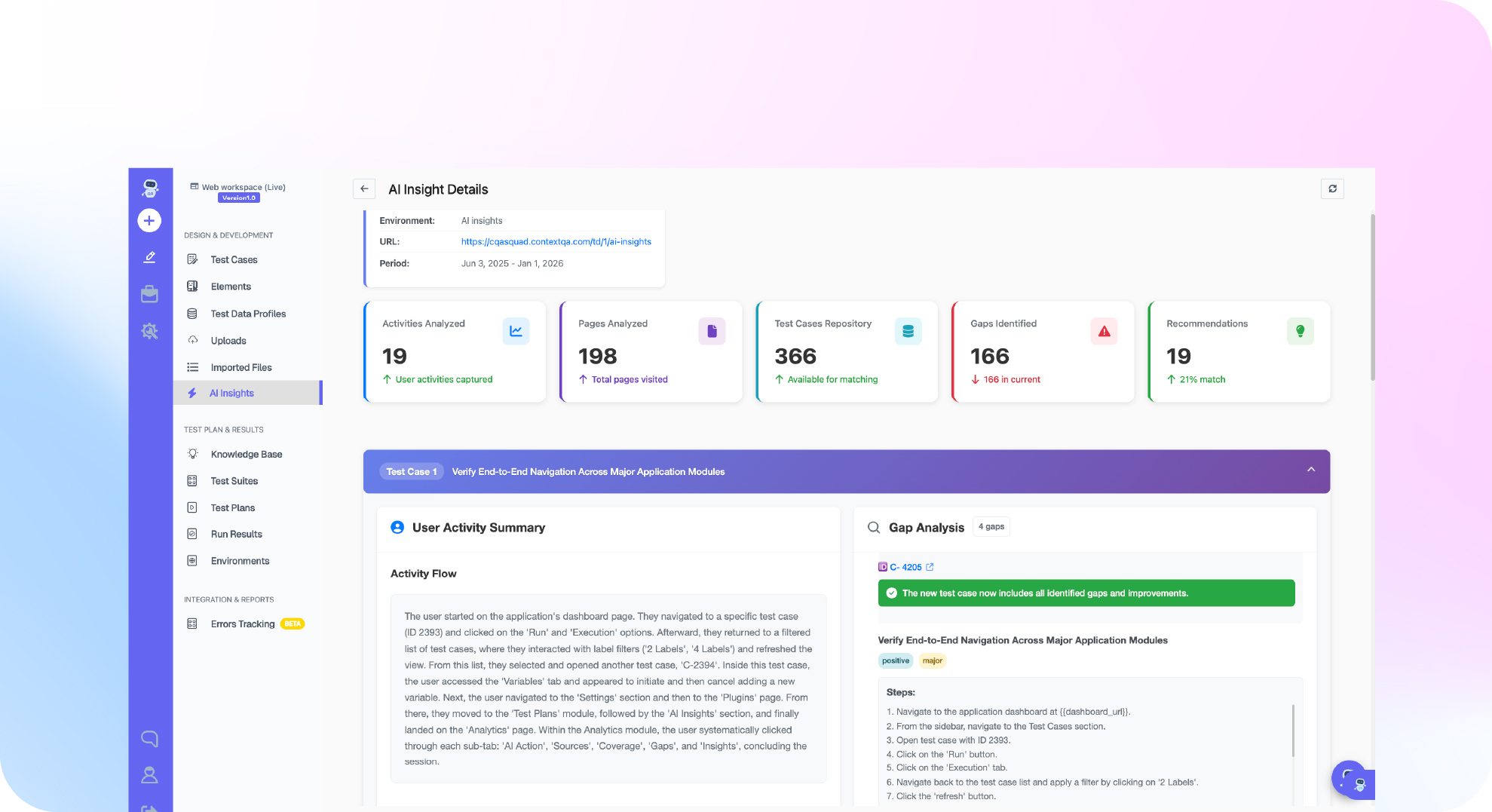
ContextQA does not replace your SDLC model. It works inside each loop of a spiral project. In the build and test step, the platform generates test cases from that loop's requirements, runs them in CI, and repairs broken locators. Each risk review then starts from current evidence instead of a stale manual suite.
One loop, following the generate tests from requirements tutorial:
- Upload the loop's spec as a
.pdf,.docx,.xlsx,.csvor.txtfile. Answer the AI's clarifying questions, then approve the cases you want. Each case maps back to the requirement it covers, so the risk review can see which objectives have tests. - Run the accepted suite on every build from Jenkins or GitHub Actions, and send results to Jira, Slack or GitHub.
- When the next loop changes the UI, self healing repairs selectors and locators, so nobody rewrites tests by hand.
- Export the suite to Playwright to keep it in your repository, or drive it from Claude Code or Cursor through the MCP server.
If every spiral loop leaves your team rewriting regression tests by hand, see how ContextQA generates tests from requirements and runs them in CI each loop: Book a demo.

What should you do right now? A checklist
Before you adopt the spiral model, check that your project carries enough unresolved risk to justify repeated loops. Then name an owner for each loop's risk review and attach automated tests to every turn. That way each loop ends with test results the team can check, not opinions about progress.
- Rank your top five project risks by likelihood and cost of failure.
- Choose spiral when risks are still unknown, agile or V model when requirements are stable.
- For loop one, write exit criteria that name the risk it removes and the test that proves it.
- Assign a named reviewer to sign off each loop's risk review.
- Turn each loop's specs into test cases and run them in Jenkins or GitHub Actions on every build.
- Automate regression for features from earlier loops, and test each new prototype by hand.
- Log defects per loop and use them to set the next loop's objectives.
- Pick a framework for each test layer with the framework selection guide.
Bottom line
The SDLC names the work, and the spiral model is one way to order it. Use the spiral when large unknowns or expensive late changes justify a risk review every loop; agile fits small SaaS teams, and waterfall fits fixed scope. Automate regression first, then each loop's risk checks, and run both in CI on every turn. To see how AI changes each phase, read our guide to the AI SDLC.
Sources
These are the primary sources behind the model definition, the cost of an inadequate software testing infrastructure and the delivery benchmarks cited above. Each link opens the original paper or report, not a summary of it.