TL;DR: Build your own test automation framework when testing is your core product or your needs are too niche for any tool. Buy a platform when you want coverage fast, predictable cost, and no maintenance team. For most teams in 2026, buying wins, because poor software quality already cost US organizations 2.41 trillion dollars in 2022 (CISQ), and an in-house framework adds a salary line, not just a tool. This guide gives you the cost model, the hidden costs, and a five question decision framework.
Definition: Build vs buy test automation is the decision between writing and maintaining your own automated testing framework in code (build) versus subscribing to a platform that generates, runs, and maintains tests for you (buy). It builds on test automation, which ISTQB defines as using software to control test execution and compare actual results to expected ones (ISTQB).
Quick answers
Should we build or buy test automation? Buy if you want results in weeks and a predictable bill. Build if testing tooling is a competitive advantage you must own, or your stack is so unusual that no platform fits. Most teams overestimate how custom their needs really are.
Is it cheaper to build an in-house test framework? Rarely, once you count people. A framework is free to download and expensive to keep alive. The real cost is the engineers who write and maintain it, not the open-source library they start with.
How long does it take to build test automation in-house? Plan for three to six months before a home-grown framework covers real flows reliably, then ongoing maintenance forever. A platform usually has your first critical flows running in days.
Should you build or buy test automation?
The honest answer is that it depends on one thing: whether testing infrastructure is something you need to own as a differentiator, or something you need to work so your team can ship. If it is a differentiator, build. If it is plumbing, buy. Everything else in this guide is about pressure testing that single question with real numbers.
Here is the trap. Building feels cheaper because the starting tools are free. Selenium, Playwright, and the rest cost nothing to install. So a manager looks at a zero on the license line and assumes building is the frugal choice. The license was never the cost. The cost is the people who turn that library into a working, maintained, trusted test suite, and keep it green while your app changes every week.

What does it really cost to build test automation in-house?
The cost of building is mostly salary. A single test automation engineer in the United States costs well over 100,000 dollars a year in base pay alone, before benefits, before tooling, before management overhead (PayScale). A real framework needs more than one of them, and it needs them indefinitely, because a test suite is never finished.
Think of the build cost in four buckets. First, framework engineering: the people who design the harness, the runner, reporting, and CI wiring. Second, infrastructure: the browser grid, devices, and cloud compute. Third, maintenance: the largest and most underestimated bucket, the constant repair of tests that break when the UI shifts. Fourth, ramp time: the months before any of it produces trustworthy coverage. The buy cost, by contrast, lands in two buckets: a subscription and a short onboarding.
To put a rough number on it, model it like this. Build cost per year is roughly the number of automation engineers times their loaded salary, plus infrastructure, plus the opportunity cost of the months before coverage exists. Buy cost per year is the subscription plus onboarding. The moment your build needs two or more dedicated engineers, the math usually tips toward buying, because two loaded salaries dwarf most platform subscriptions. Run your own numbers before you decide. Our breakdown of test automation ROI shows how to frame the return side of that equation.
| Factor | Build in-house | Buy a platform |
|---|---|---|
| Upfront cost | Low license, high salary | Subscription |
| Time to first coverage | Months | Days |
| Maintenance owner | Your engineers | The vendor |
| Scales with your app | Needs more headcount | Built in |
| Risk if a key engineer leaves | High (knowledge walks out) | Low |
| Best when | Testing is your product | Testing must just work |
What does a test automation platform actually cost?
A platform converts an unpredictable salary line into a predictable subscription line. That is the real trade. You give up total control over the internals, and in return you get coverage you do not have to staff, infrastructure you do not have to run, and maintenance you do not have to do. The automation testing market is projected to reach 24.25 billion dollars in 2026, which tells you how many teams have already made that trade (Fortune Business Insights).
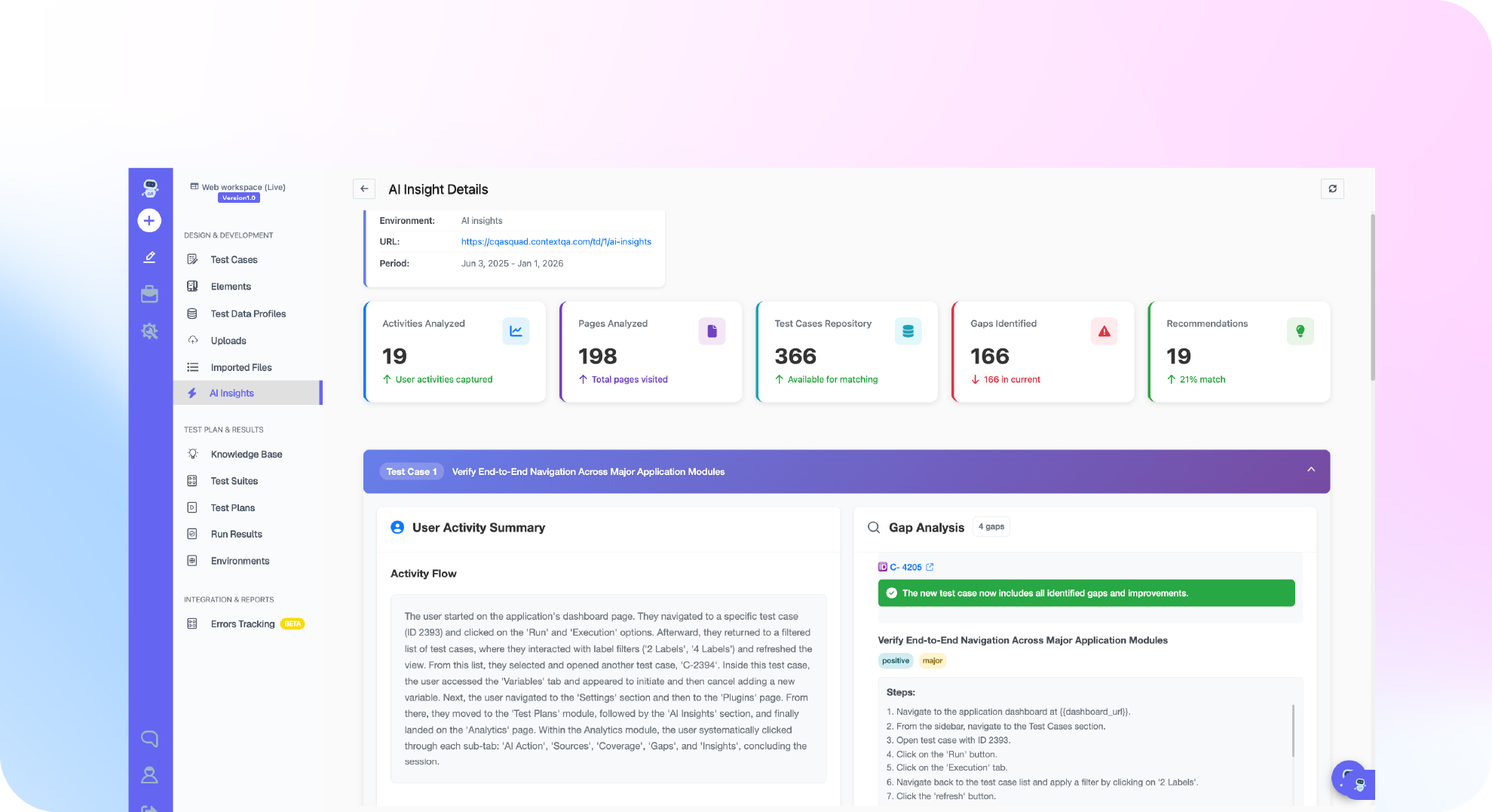
The buy side also moves faster because the hard parts are already solved. Cross-browser execution, real-device coverage, self-healing locators, and failure analysis ship on day one. With a platform like ContextQA, your first critical flow can be running across real browsers in an afternoon, not a quarter. That speed is the point: every week your suite is not running is a week of regressions you are catching by hand or not at all.
The hidden costs of building in-house
The sticker price of building is the salaries. The hidden price is everything that erodes the suite after launch. Three costs surprise teams again and again.
The first is maintenance from flakiness. Flaky tests are not a rounding error. Google’s own research on its codebase found that roughly 1.5 percent of all test runs flake, affecting around 16 percent of tests over time (Google Research). In a home-grown suite, every one of those flakes is your engineer’s afternoon. A renamed button, a moved field, a slow API, and the test goes red, and someone has to investigate and fix it.
The second hidden cost is ramp time. A framework does not pay you back on day one. For the first quarter or two it is a cost center with little coverage to show, while the team learns the patterns and fights the early flakiness. A platform compresses that to days because the patterns are already built. AI-based self-healing is the clearest example: instead of an engineer rewriting a broken locator, the platform re-identifies the element across visual, accessibility, DOM, and text signals and keeps the test green.
The third hidden cost is key-person risk. A home-grown framework lives in the heads of the two or three people who built it. When one leaves, part of your testing capability walks out the door, and the next hire spends months learning an undocumented system. A platform has no single point of human failure, because the knowledge is in the product, not in a contractor who moved on.
Why poor software quality is the cost you are really fighting
Step back from tooling for a second, because the build versus buy debate is downstream of a much bigger number. Poor software quality cost US organizations an estimated 2.41 trillion dollars in 2022, and accumulated software technical debt reached roughly 1.52 trillion dollars (CISQ). The point of test automation is to take a bite out of that number. The build versus buy question is only about which path gets you there faster and cheaper.
When does building test automation make sense?
Building is the right call more often than never, just less often than teams assume. Choose build when these are true for you.
- Testing is your product. If you sell a testing tool or your edge is a unique quality process, you should own that stack.
- Your environment is genuinely unusual. Exotic protocols, custom hardware, or air-gapped systems that no platform supports.
- You already have a strong, funded automation team. Engineers who want to own the framework and a budget that funds them for years, not quarters.
- Control and customization outrank speed. You would rather wait and shape every detail than get coverage next week.
When does buying win?
Buying wins for the majority of teams, especially as AI moves more of the work into the platform. The 2024 DORA report found that 75.9 percent of developers now rely on AI for at least part of their work, and that shift is pushing testing the same way (DORA). Choose buy when these are true.
- You need coverage this quarter, not next year. Speed to first reliable test matters more than owning the internals.
- You want a predictable bill. A subscription is easier to forecast than a growing headcount.
- You do not want to staff maintenance. Self-healing and managed infrastructure take the repair work off your team.
- Your app changes constantly. A platform absorbs UI churn that would otherwise bury an in-house suite.
A five question build vs buy decision framework
Score each question honestly. More “buy” answers than “build” answers means buy, and the reverse means build. This is the part to take into the meeting.
What buying done right looks like
Buying is only the better choice if the platform actually removes the work you were trying to avoid. The proof is in real migrations. When IBM worked with ContextQA, the team moved about 5,000 test cases onto the platform and removed the flakiness that had been slowing them down (IBM case study). That is the scale where buying clearly beats building, because no in-house team rewrites 5,000 stable tests on the side.
Two capabilities carry that promise. The first is the AI testing suite, which generates and runs tests from plain English across real browsers, so coverage grows without a growing team. The second is root-cause analysis, which classifies each failure as a real bug, a test issue, an environment problem, or a flake, so a red build becomes a clear next step instead of an engineer’s investigation. Those two features are exactly the work you would otherwise be hiring for. If you want the deeper evaluation lens, our guide to the best AI QA platform options walks through how to compare vendors, and why teams pick ContextQA covers the differentiators.
Your build vs buy checklist
- Count the people, not the license (15 minutes). Add up the loaded salaries a real in-house framework would need, then compare to a subscription.
- Estimate ramp time (10 minutes). Be honest about how many months until home-grown coverage is trustworthy.
- Map your maintenance load (15 minutes). List how often your UI changes, because that is your future flaky-test bill.
- Run the five questions (10 minutes). Tally build versus buy answers with your team in the room.
- Pressure test “we are too custom” (10 minutes). Try one real flow on a platform before you assume nothing fits.
- See it on your own app. Bring your trickiest flow and book a demo to watch a platform generate, run, and heal it live.
How to run the build vs buy numbers (a worked example)
Make it concrete with your own inputs. Start with the build side: count the automation engineers a real framework needs, multiply by their loaded cost, and add infrastructure. With a single test automation engineer costing well over 100,000 dollars a year in base pay alone (PayScale), two dedicated engineers plus benefits, tooling, and a browser grid easily clears a quarter of a million dollars annually, every year, indefinitely. That is before you count the manager who reviews their work.
Now the buy side: a platform subscription plus a short onboarding. You do not need an exact vendor quote to see the shape of the answer. If your honest build estimate needs two or more full-time engineers, a platform almost always costs less than those salaries, and it delivers coverage in days instead of quarters. The crossover point is simple to remember. One part-time script writer can sometimes justify building. Two dedicated engineers almost never can. When the numbers are close, weigh the speed: the in-house path also carries months of zero coverage, and every uncovered week is risk you are absorbing by hand.
Build vs buy is not all or nothing
The smartest teams rarely pick a pure side. They buy the platform for the 95 percent of testing that is web flows, mobile, and APIs, then keep a thin custom layer only for the genuinely unique 5 percent. This hybrid path gives you speed and coverage where it is commodity, and control where it actually matters. You stop paying salaries to reinvent cross-browser execution, and you spend your engineering time on the parts no vendor could know about.
A platform that is built to be extended makes the hybrid path easy. ContextQA exposes its tools to AI agents and CI systems through an AI testing suite and an MCP server, so your custom layer talks to the platform instead of duplicating it. The question stops being build or buy. It becomes buy the foundation, then build only the part that is truly yours.
How AI changed the build vs buy math in 2026
For years the case for building rested on two costs that platforms could not remove: maintenance and ramp time. AI changed that. Self-healing now absorbs the locator churn that used to be an engineer’s afternoon, and plain-English generation collapses the months of ramp into days. The two biggest reasons to build in-house have quietly moved into the buy column. With 75.9 percent of developers already using AI in their workflow (DORA), the gap keeps widening.
One caution keeps this honest. AI can make a team feel faster than it is. A 2025 METR study of experienced developers found they expected AI to speed them up by about 20 percent, yet they were actually 19 percent slower on the measured tasks (METR). The lesson for build versus buy is to judge a platform on measured cycle time on your own app, not on a slick demo. Buy for proven speed, not promised speed.
Common mistakes in the build vs buy decision
Most regret in this decision traces back to a handful of avoidable errors. Watch for these before you commit.
- Counting the license, not the salaries. The open-source library is free. The team that keeps it alive is not. This is the single most common mistake.
- Assuming you are too custom to buy. Most stacks are far more standard than their owners believe. Test one real flow on a platform before you rule it out.
- Ignoring ramp time. A build that pays off in year three still leaves years one and two thin on coverage. Price that risk in.
- Forgetting key-person risk. A framework that lives in two people’s heads is one resignation away from a crisis.
- Buying on the demo, not the data. Run a trial on your own app and measure real cycle time before you sign.
What to measure after you decide
Whichever way you go, prove it with numbers within a quarter. Track four: time to first reliable coverage, maintenance hours per sprint, flake rate, and escaped defects that reached production. If you built, watch whether maintenance hours creep up as the app grows. If you bought, watch whether coverage widened without new headcount. The right decision shows up as maintenance falling while coverage rises. The wrong one shows up as a team that spends more time fixing tests than writing them.
Does company size change the build vs buy answer?
Yes, and it usually points the same direction for different reasons. A startup should almost always buy, because every engineer is precious and none should be spending months on a test harness instead of the product. Speed to coverage is survival, and a subscription is far easier to justify than a hire you cannot afford to lose.
A scaleup feels the pull to build, because it finally has a few engineers who could do it, and the suite is growing fast. This is the most dangerous moment, because the maintenance bill grows quietly while the team is busy shipping features. Buying keeps the suite from becoming a second product nobody planned to own. An enterprise has the budget to build, but rarely the appetite, because key-person risk and audit requirements make a supported platform safer. The IBM migration of about 5,000 test cases is the enterprise pattern in one line: even teams that could build choose to buy at scale (IBM case study). Across all three sizes, the constant is that people are the cost, and people are exactly what a platform lets you spend elsewhere.
Does open source make building cheaper?
Open source lowers the license cost to zero and changes nothing about the real bill. Selenium and Playwright are excellent, free, and widely used, and they still need engineers to assemble them into a framework, wire them into CI, build reporting, run the grid, and fix the breakages. Free libraries are the starting line, not the finish line. The honest way to read a zero on the license line is this: the cost did not disappear, it moved onto your payroll. That is the whole build versus buy decision in a sentence.
The bottom line
Build test automation when it is your edge. Buy it when it is your foundation. The cost of building is rarely the tool and almost always the people, the months, and the maintenance, while the cost you are really fighting is the 2.41 trillion dollars that poor software quality drains every year. For most teams in 2026, buying gets you to quality faster, cheaper, and with less risk than building. Run the five questions, count the people rather than the license, and pressure test the assumption that your stack is too custom to buy, because that assumption is wrong far more often than it is right. Want to see which side your team is on? Book a demo and bring the flow you are most worried about.