
TL;DR: Open source testing tools like Selenium and Playwright are free to download, but you pay in infrastructure, maintenance, expertise, and support. Commercial platforms charge a subscription but hand all of that to the vendor. Open source wins when you have strong engineers, time, and a need for control; commercial wins when you need fast, low-maintenance coverage and a team that is not all coders. The right answer is the lowest total cost of ownership that fits your team, not the lowest sticker price. This guide shows how to score it.
Definition: Open source vs commercial testing is the choice between adopting free, community-built test automation frameworks and buying a paid, vendor-supported testing platform. Both automate testing, which ISTQB defines as using software to control test execution and compare actual results to expected ones. The difference is who owns the setup, maintenance, infrastructure, and support: you, or the vendor, and that ownership is where the real cost lives. This guide is written for QA and engineering teams choosing their tooling.
Quick answers
Is open source testing really free? The license is free; the tool is not. You take on the cost of infrastructure, the grid, ongoing maintenance, specialist engineers, and your own support. Those costs are real, they are just not on an invoice.
When should you choose a commercial testing tool? When you need coverage fast, your team is not all coders, you do not want to run infrastructure, or maintenance is already eating your QA time. You are paying to make those problems the vendor’s job.
Open source or commercial, which is cheaper? It depends on your team. With strong in-house engineers and time, open source can be cheaper. Once you price in maintenance, infrastructure, and the engineers’ hours, a commercial platform is often cheaper at total cost of ownership.
Open source vs commercial testing tools at a glance
The trade is the same in every category of tool: control versus convenience. With open source you get total flexibility and own everything, including the work. With commercial you trade some flexibility for the vendor doing the heavy lifting. Here is the split side by side.
Neither column is better in the abstract; they are better for different teams. A team of senior automation engineers reads the left column as freedom. A small team under a deadline reads the right column as relief. The whole decision is figuring out which description fits you, and our roundup of the best AI QA platforms and the Playwright vs Selenium vs Cypress comparison cover the specific tools in each camp.

What ‘free’ open source testing actually costs
The most expensive word in tooling is ‘free,’ because it hides the bill. Open source frameworks cost nothing to download and a great deal to run. Before you choose one to save money, look at what you are actually signing up to own.
Maintenance is the big one. As your application changes, your test scripts break, and someone has to fix them, every sprint, forever. Flaky tests pile on top: Google research found roughly 1.5 percent of test runs flake and about 16 percent of tests are affected over time, and in an open source suite every one of those is your team’s problem to chase. Poor quality is not cheap either; CISQ put the cost of poor software quality in the US at 2.41 trillion dollars. ‘Free’ tooling that lets defects through is the most expensive option of all.
Where open source wins
Open source is not the weak choice; for the right team it is the strong one. The community-built frameworks are excellent, and State of JS 2025 shows tools like Playwright earning some of the highest developer satisfaction scores anywhere. If your team has the engineering depth to run them, open source gives you four real advantages: zero license cost, total control over the framework, no vendor lock-in, and the ability to customize anything. For a team that wants to own its automation end to end, nothing beats it.
The teams that win with open source share a profile: strong automation engineers, time to build and maintain, a need for deep customization, and the operational maturity to run infrastructure. If that is you, the flexibility is worth the work, and the lack of a license fee is a genuine saving rather than a hidden cost waiting to surface.
Where commercial platforms win
Commercial platforms win on everything you would otherwise have to build and run yourself. The vendor provides the infrastructure and grid, maintains the tool, scales it, supports it with an SLA, and ships features you did not have to develop. That turns a multi-month standup into a same-week start, and it frees your engineers to test rather than to maintain a framework. The cost is a subscription and some loss of low-level control.
The teams that win with commercial also share a profile: a need for fast coverage, a team that is not all coders, no appetite for running infrastructure, or a maintenance burden that is already out of hand. The strongest commercial platforms add DORA-era capabilities like AI authoring and AI-based self-healing that survives UI changes, which directly attack the maintenance cost that makes open source expensive. You are buying time and predictability.
How to choose between open source and commercial
Do not choose on price or preference; choose on total cost of ownership and fit. Run this five-step process and the answer usually becomes obvious, because it forces you to count the costs that ‘free’ hides.
The step teams skip is estimating total cost of ownership honestly. License is the smallest line. Add the engineers’ time to build and maintain, the infrastructure to run it, the cost of slower coverage, and the risk of defects that slip through. Then compare that full number to a subscription. Often the ‘expensive’ commercial option is the cheaper one once the people and infra are counted.
When is each one the right call?
Map your situation to the better fit. These are not absolute rules, but they hold for most teams.
| Your situation | Better fit |
|---|---|
| Strong automation engineers, time, and a need for control | Open source |
| Small team, fast coverage needed, no infra appetite | Commercial |
| Non-coders must be able to contribute tests | Commercial or codeless |
| Tight budget but deep automation expertise on hand | Open source |
| Maintenance is already drowning your QA team | Commercial with self-healing |
If your row points to commercial, the reason is almost always the same: the cost you are trying to avoid is bigger than the subscription. If it points to open source, you have the people and time to turn ‘free’ into actually free.
Open source vs commercial is not the same as build vs buy
These two decisions get confused, and they are different. Open source vs commercial is a choice between two kinds of existing tools: a free framework or a paid platform. Build vs buy is a choice between assembling your own testing solution or adopting someone else’s. You can buy into open source and still build a huge amount around it, the glue, the grid, the reporting, which is exactly why ‘free’ open source can cost more than a platform. Our build vs buy decision guide covers that second decision in depth, and the two together frame the full tooling strategy.
The clean way to think about it: build vs buy decides how much you make yourself; open source vs commercial decides what you start from. A team can buy a commercial platform and build little, or adopt open source and build a lot. Naming which decision you are actually making stops you from comparing a license fee to a subscription and missing the engineering bill in between.
Can you mix open source and commercial?
Yes, and many mature teams do. A common pattern is open source frameworks for the deep, custom, developer-owned tests, and a commercial platform for broad UI coverage, non-coder contribution, and the maintenance-heavy end-to-end suites. The frameworks give control where control matters; the platform absorbs the parts that are pure overhead. The two are not mutually exclusive.
The trick with a hybrid is to draw the line on purpose, not by accident. Decide which tests live where based on who owns them and how often they break, then keep the boundary clean so you are not maintaining two half-built systems. Done well, a hybrid gives you the control of open source where you want it and the convenience of commercial where you need it.
How ContextQA fits this decision
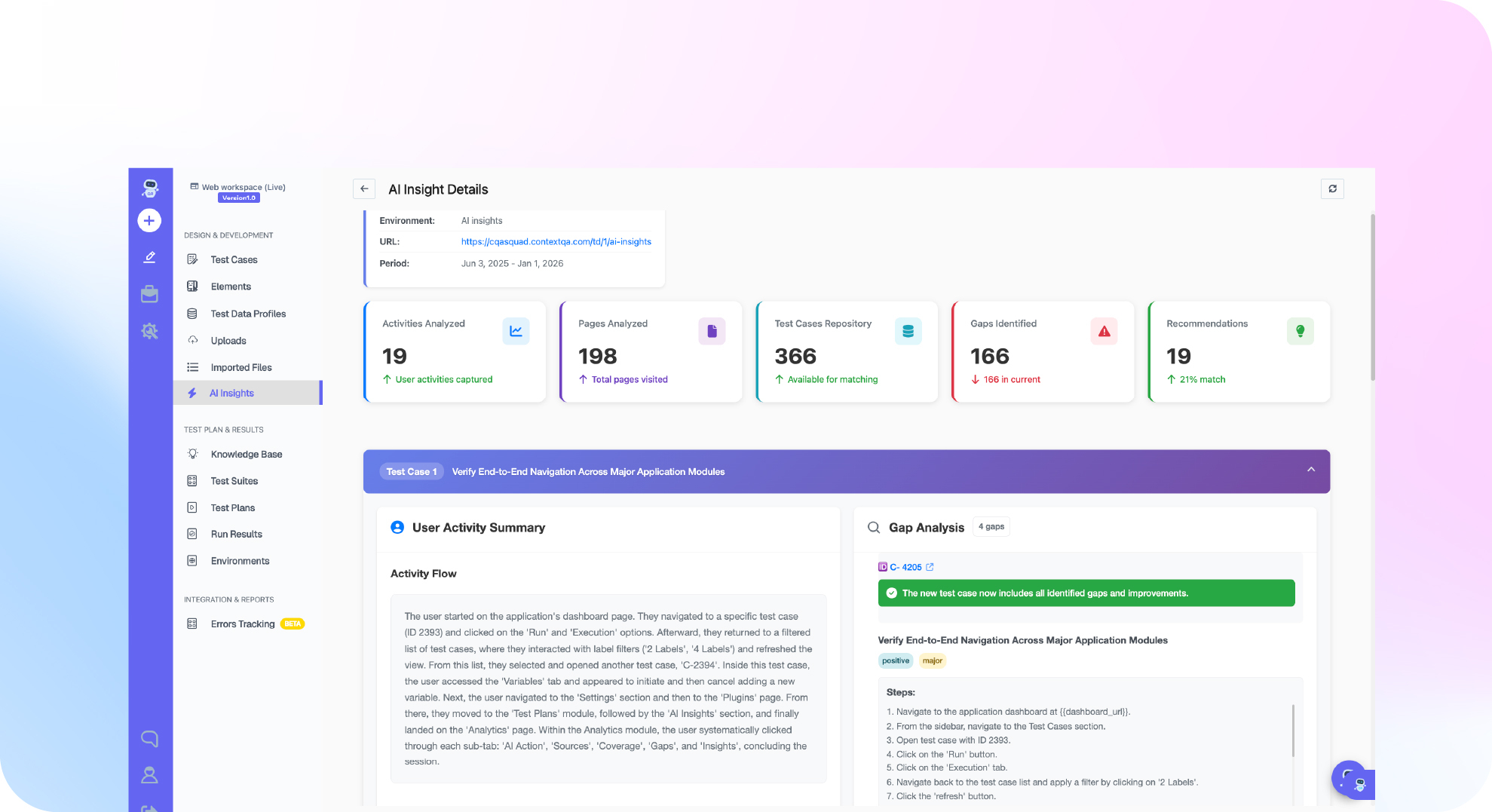
ContextQA is a commercial platform, so it is fair to say where it sits. It exists for the teams the right-hand column describes: those who want fast coverage without running infrastructure, non-coders who need to contribute, and teams whose maintenance has become the bottleneck. AI-based self-healing attacks the single biggest hidden cost of open source by re-identifying elements when the UI changes, so scripts do not break every sprint. The whole AI testing suite runs across real browsers and devices that the vendor scales for you.
The proof that this offsets real cost is in adoption. When IBM worked with ContextQA, the team migrated about 5,000 test cases and removed the flakiness that had been slowing them down (IBM case study). At that scale, the maintenance an open source suite would demand is exactly the cost a platform removes. If you are weighing the two, run your own total-cost-of-ownership numbers, then see why teams choose ContextQA and put us on the list with the best API testing tools and any framework you are considering.
Common mistakes in the open source vs commercial decision
- Comparing license fee to subscription. Count people and infra too, or you are comparing the wrong numbers.
- Treating “free” as free. Open source bills you in maintenance and engineering hours instead.
- Ignoring who maintains it. If your experts leave, an open source suite can become unmaintainable legacy code.
- Buying commercial for control you will not use. If you genuinely need deep customization, a platform can frustrate you.
- Deciding once and never revisiting. The right answer changes as your team and app grow.
Every one of these comes back to total cost of ownership. Price the whole thing, including the work, and the decision stops being about ideology and starts being about math.
Your open source vs commercial checklist
- Write down your real needs (20 minutes). Coverage, team skills, timeline, and budget.
- Estimate total cost of ownership for both (1 hour). License plus people, infra, maintenance, and risk.
- Trial a framework and a platform on your own app (1 to 2 weeks). Real flows, not a demo.
- Check who maintains each long term. Name the owner; avoid single-expert risk.
- Score on TCO and fit, then decide. Lowest total cost that fits the team wins.
- Put a platform on the list. Bring a flow and book a demo to compare it against your framework on real numbers.
How much does open source test automation really cost?
Model it like this. The license is zero. Now add the people: even a part of one automation engineer’s salary to build and maintain the suite is a real annual number, and most teams need more than a part of one. Add infrastructure: the machines, browsers, and grid to run tests in parallel, plus the orchestration to manage them. Add the slow start, because a framework does not pay you back on day one while the team builds it out. The license was free; the program was not.
Now put a commercial subscription next to that full number, not next to zero. A platform that replaces the maintenance hours, the infrastructure, and the build time is competing with salaries and servers, not with a free download. Framed that way, the subscription that looked expensive against “free” often looks cheap against the real cost of running open source at scale. That reframing is the entire point of a total-cost-of-ownership comparison.
Does open source mean lower quality?
No. The leading open source frameworks are excellent, often better engineered than paid tools in their specific niche, and they are maintained by large, active communities. Quality of the tool is not the issue. The issue is the quality of the test program you build around it, which depends on your team’s discipline, time, and expertise. A great framework in an under-resourced team produces a flaky, half-maintained suite; the framework is not at fault, the operating model is.
This is why the decision is about your team, not the tool’s pedigree. Commercial platforms do not win because the underlying technology is better; they win because they supply the operating model, the maintenance, infrastructure, and support, that an open source tool leaves to you. If your team can supply that model itself, open source quality is as high as anything you can buy. If it cannot, the platform’s value is the model, not the engine.
What about support when something breaks?
This is one of the sharpest differences. With open source, support is the community: forums, issues, and documentation. For a capable team that is often enough, and the answers are usually out there. But when a critical suite breaks the night before a release, “open an issue and wait” is not a plan, and there is no one contractually obligated to help you. The support cost of open source is the time your own engineers spend being the support team.
Commercial platforms sell exactly this peace of mind: a support contract, an SLA, and a vendor whose job is to keep you running. For teams where testing blocks releases and downtime is expensive, that guarantee is a large part of what the subscription buys. Weigh it honestly. If your team can self-support without missing releases, you do not need to pay for an SLA. If it cannot, the SLA is not overhead, it is insurance.
How fast do you get to first coverage with each?
Time to first reliable coverage is where the two diverge most visibly. With a commercial platform, you can often have meaningful tests running within days, because the infrastructure, authoring, and reporting are already built. With open source, the same milestone takes longer, because you are standing up the framework, the grid, and the conventions before you write much that lasts. Neither is wrong; they are different shapes of investment.
If speed to coverage matters, for a launch, a compliance deadline, or simply to show value fast, that early gap weighs toward commercial. If you are building a long-term capability and can invest up front, open source’s slower start is a fair price for the control you gain. Match the choice to your timeline, and measure real coverage rather than the feeling of progress, because a framework can feel productive long before it actually protects a release.
A worked example: a five-person QA team decides
Picture a five-person QA team supporting a fast-moving web app, with two engineers who can code and three who cannot. They consider open source first because it is free. Then they count: the two coders would spend a large share of their week building and maintaining a framework, the three non-coders could not contribute to it at all, and they would need to stand up a grid. The “free” option quietly consumes most of their automation capacity in overhead.
A commercial platform changes the math. The three non-coders can author tests in plain language, the two engineers focus on the hard, custom cases, self-healing absorbs the maintenance that would have eaten their week, and the vendor runs the grid. The subscription costs money, but it converts five people into five contributors instead of two maintainers. For this team, commercial is not the expensive choice; it is the one that makes the whole team productive. A different team, five senior automation engineers with time, would run the same exercise and land on open source. The process is the point, not the answer.
Should a startup use open source or commercial?
It depends less on the budget and more on where the team’s time is best spent. Early-stage startups reach for open source by reflex because cash is tight, which is reasonable. But a startup’s scarcest resource is usually engineering time, not money, and time spent building and babysitting a test framework is time not spent on the product. If your engineers are your moat, having them maintain a grid instead of shipping features is an expensive kind of free.
The pragmatic startup answer is often a commercial platform with a small footprint early, then a reassessment as the team grows. You get coverage fast, you keep engineers on the product, and you avoid building infrastructure you may outgrow anyway. Once you have the headcount and a dedicated automation function, revisit the decision; what was right at five engineers may not be right at fifty. The point is to choose deliberately at each stage, not to default to “free” and discover the bill in lost product velocity.
The bottom line
Open source vs commercial testing is a total-cost-of-ownership decision, not a sticker-price one. Open source is free to license and expensive to run; commercial costs a subscription and removes the infrastructure, maintenance, and support you would otherwise own. Strong engineering teams with time win with open source; teams that need fast, low-maintenance coverage win with commercial. Count the whole cost, including the engineering hours that ‘free’ hides, and let the math decide rather than the sticker price or a preference for one camp. The teams that get this right are the ones that priced the work, not just the license. Want to compare a commercial platform against your framework on your own numbers? book a demo and bring a real flow.