
TL;DR: The BDD testing tools landscape changed more in the last two years than in the previous ten: SpecFlow, the .NET standard, was discontinued and reborn as Reqnroll, and AI platforms now deliver BDD’s collaboration benefits without Gherkin maintenance. This 2026 list ranks the 10 BDD testing tools worth evaluating: ContextQA, Cucumber, Reqnroll, Behave, Karate, JBehave, Behat, Gauge, Concordion, and FitNesse, with the language, the best-fit team, and the honest trade-off for each.
What Is Behavior Driven Development, and Why Does It Matter?
Behavior driven development (BDD) is a collaboration practice where business stakeholders, developers, and testers define application behavior together in structured plain language, usually the Given-When-Then format, and those definitions become executable tests. The test suite and the requirements document are the same artifact, so when behavior drifts from the specification, a scenario fails and everyone finds out immediately.
The catch, and the reason tool choice matters, is the middle box. Binding every plain-language line to step code is real engineering work, and teams that underestimate it end up maintaining two codebases: the app and the glue. The tools below differ mostly in how much of that glue they make you write and maintain.
What Changed in BDD Tools for 2026
SpecFlow is gone. Tricentis discontinued the most widely used .NET BDD framework, and the community regrouped around Reqnroll, an open-source reboot of the SpecFlow project led by its original creator. If your suite still runs SpecFlow, migration to Reqnroll is the maintained path, and it is deliberately near-drop-in.
AI changed the economics. The historic BDD trade was: accept Gherkin and step-definition maintenance in exchange for business-readable tests. AI-native platforms now offer that readability directly, generating and self-healing tests from plain English descriptions of behavior, which removes the glue-code layer entirely. That is why an AI platform leads this list rather than a classic framework.
Top 10 Behavior Driven Development Testing Tools
1. ContextQA
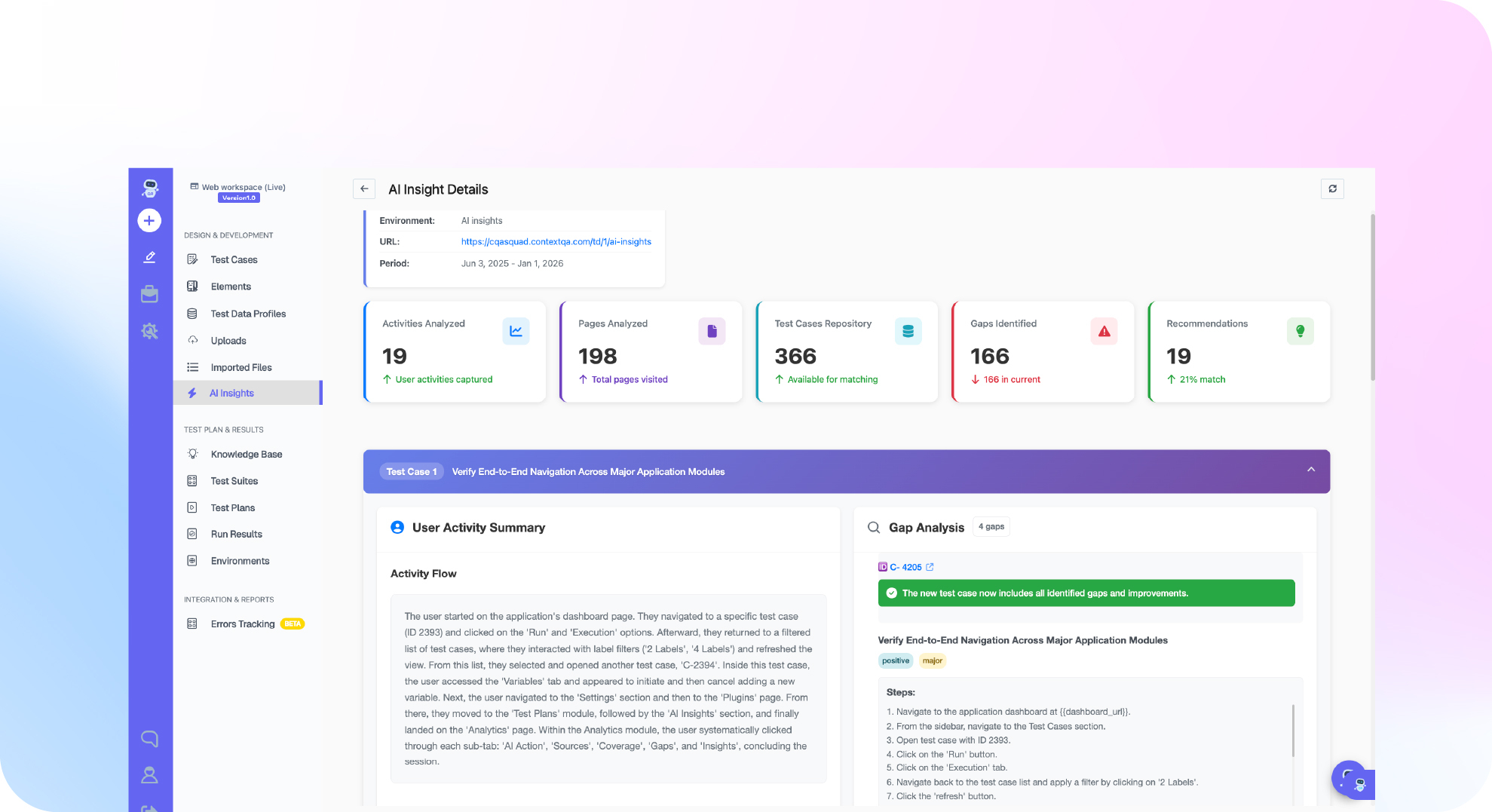
ContextQA delivers the outcome BDD promises, tests any stakeholder can read and trust, without the Gherkin layer that makes classic BDD expensive. Teams describe behavior in plain English or record real user flows; the platform generates the executable tests, binds them to the application model, and self-heals them when the UI changes. Scenarios stay business-readable while maintenance drops by 70% or more.
Best for: teams that want BDD’s collaboration and living-documentation benefits at modern release speed, without hiring for step-definition upkeep. Trade-off: it is a commercial platform, not a free framework; the business case is maintenance time, covered in our ROI breakdown.
2. Cucumber
The reference implementation of BDD and the reason Gherkin exists. Cucumber runs Given-When-Then feature files against step definitions in Ruby, JavaScript, or Java (via Cucumber-JVM), and its ecosystem, plugins, reporters, CI integrations, and a two-decade knowledge base, is the largest in the category.
Best for: teams committed to classic Gherkin BDD with strong developer capacity. Trade-off: step-definition maintenance grows with the suite, and UI selectors inside step code break like any other script.
3. Reqnroll (the SpecFlow successor)
Reqnroll is the open-source reboot of SpecFlow for .NET, created by SpecFlow’s original author after Tricentis discontinued the project. It keeps the Gherkin syntax, the Visual Studio tooling experience, and a compatibility layer that makes most SpecFlow suites migrate with minimal changes.
Best for: every .NET team still on SpecFlow, which is now unmaintained. Trade-off: a younger project carrying a large inherited scope; pin versions and follow releases.
4. Behave
Behave is Python’s standard Gherkin framework: feature files on top, Python step implementations underneath, clean pytest-style fixtures for setup. Python teams adopting BDD almost always land here or on pytest-bdd.
Best for: Python-first engineering teams. Trade-off: smaller plugin ecosystem than Cucumber; browser automation still needs Selenium or Playwright underneath.
5. Karate
Karate takes a different path: a Gherkin-flavored DSL where the steps are already implemented for API testing, so there is no step-definition code to write at all. HTTP calls, JSON assertions, and even performance tests live directly in the feature file.
Best for: API-first BDD; the fastest zero-glue start in the classic tools. Trade-off: its UI testing module is far less mature than its API side.
6. JBehave
One of the original BDD frameworks for Java, predating Cucumber-JVM. It remains solid and battle-tested in enterprises that adopted it a decade ago.
Best for: Java estates already invested in it. Trade-off: for new Java projects, Cucumber-JVM has the momentum, docs, and hiring pool.
7. Behat
Behat is the PHP implementation of Gherkin BDD, tightly integrated with Symfony and the Mink browser abstraction. In PHP shops it is effectively the only serious choice, which keeps it well maintained.
Best for: PHP product teams. Trade-off: ecosystem begins and ends with PHP.
8. Gauge
Gauge, from ThoughtWorks, swaps Gherkin for Markdown: specifications read like documents, with steps as bullet points bound to code in Java, JavaScript, Python, or C#. The result is unusually readable specs that double as documentation.
Best for: teams that want spec-as-document ergonomics. Trade-off: development activity has slowed; evaluate community health before committing a large suite.
9. Concordion
Concordion instruments HTML documents: you write the specification as prose, and instrumentation binds sentences to Java fixtures. It produces the most polished living documentation in the category.
Best for: teams where the specification document itself is the deliverable. Trade-off: niche adoption; expect to train, not hire, for it.
10. FitNesse
FitNesse is a wiki server where acceptance tests are wiki tables executed against fixture code. It is the elder of the list and still runs in long-lived enterprise environments, particularly around decision-table-heavy business logic.
Best for: maintaining existing FitNesse estates. Trade-off: choosing it for a new project in 2026 is hard to justify.
How Do You Manage BDD Tests at Scale?
BDD test management is where most implementations quietly fail. A hundred feature files are easy; a thousand need ownership rules, deduplication, and reporting that business stakeholders actually read. Four practices separate the suites that scale from the ones that rot:
- Feature files are the single source of truth. Scenarios live in version control next to the code they describe, never copied into a separate test case manager where they drift.
- Reports speak business language. Publish scenario-level results (living documentation) to stakeholders every run, not raw CI logs. This is the loop that keeps business people participating.
- Tag strategy from day one. Tags for risk tier, feature area, and run cadence let CI select the right scenarios per change instead of running everything always, the same principle as our guide to making testing the fastest part of your pipeline.
- Measure glue-code maintenance honestly. Hours spent on step definitions and selectors are the real cost of classic BDD. When maintenance passes authoring, platforms with self-healing (see our auto-healing deep dive) become cheaper than free frameworks.
How to Choose Between BDD Testing Tools
Three questions settle it faster than any feature matrix. First, what does your team write? Match the framework to your language: Reqnroll for .NET, Behave for Python, Behat for PHP, Cucumber for Java and JavaScript, Karate for API-first work. Second, who maintains the glue? If the honest answer is “nobody has capacity,” pick a platform that removes the glue layer instead of a framework that multiplies it. Third, trial on your own application, not the demo app, with written exit criteria; our 30-day POC framework provides the structure.
Comparing the wider tool market?
BDD frameworks are one slice of the decision. Our 25-tool test automation comparison maps the full field, and the RFP scorecard covers the evaluation criteria most templates miss.
Expert Recommendations for BDD Testing
Start with three scenarios, not three hundred: pick one critical user journey, write its Given-When-Then together with a business stakeholder, automate it, and publish the living documentation. That single loop proves the practice before you invest in the tooling. Keep scenarios declarative (what the user achieves) rather than imperative (which buttons they click), because declarative scenarios survive UI changes and imperative ones die with every redesign. And treat glue code as production code: reviewed, refactored, and owned, or replaced by a platform that generates it. Teams restructuring around AI tooling should read our QA team structure guide for how these roles shift.
Final Thoughts on BDD Testing Tools
The best BDD testing tools in 2026 split into two camps: classic Gherkin frameworks (Cucumber, Reqnroll, Behave, Behat) that trade maintenance effort for full control, and AI platforms that deliver business-readable, self-maintaining tests directly. Language fit decides within the first camp; maintenance capacity decides between the camps. Whichever you choose, the practice matters more than the tool: shared scenarios, executable specifications, and documentation that fails loudly when it stops being true.
Book a demo of ContextQA to see plain-English BDD scenarios generate and maintain themselves on your own application.